PRECISION MACHINES FOR PRECISION CONNECTIONS

Common Defects in Crimping
Crimping Defects and root cause
CRIMPING TECHNOLOGY
Dhineshkumar R
6/3/20264 min read
Common Defects in Crimping:
In industrial wire processing, a perfect crimp requires precise synchronization between the wire, the terminal, and the applicator tooling. When any of these elements deviate from engineering specifications, it introduces defects that compromise the electrical and mechanical integrity of the entire wire harness.
Here is a detailed breakdown of the most common crimping defects encountered on the production floor, their technical consequences, and their root causes:
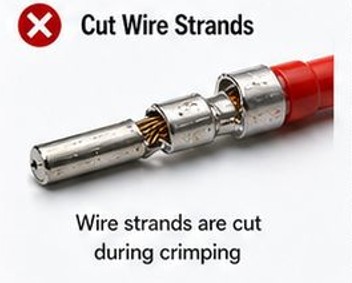
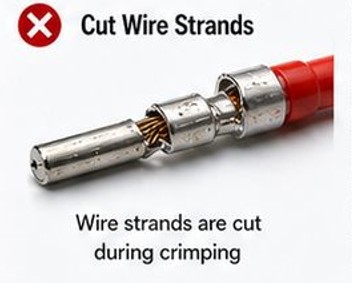
1. Wire Cut Strands:
This defect occurs when individual copper strands of the conductor are severed, nicked, or scraped during the stripping or crimping process.
Technical Consequence: Cutting the strands reduces the total cross-sectional area of the conductor. This lowers the tensile/pull-force strength of the joint, making it highly susceptible to snapping under mechanical vibration. Electrically, it creates a bottleneck for current flow, which can cause localized overheating.
Typical Root Cause: Worn, chipped, or incorrectly aligned stripping blades; choosing the wrong wire profile on an automated stripping machine; or a misaligned crimp tool anvil.
2. High Conductor Brush:
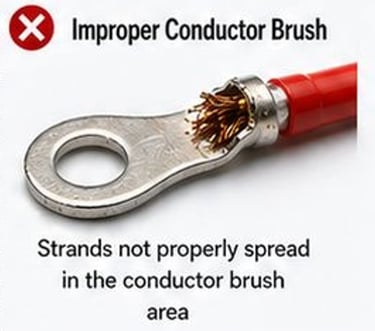
The "conductor brush" refers to the wire strands that extend past the front edge of the wire crimp barrel (mating end). A high conductor brush means the strands extend out too far.
Technical Consequence: While a slight brush is necessary to prove the wire is fully inserted, excessively long strands can physically interfere with the terminal's locking mechanism or mating components. In tight connector housings, these long strands can bend over and touch adjacent terminals, causing catastrophic short circuits.
Typical Root Cause: Incorrect wire stripping length setup or improper wire positioning/feeding depth during manual or automated insertion into the applicator.
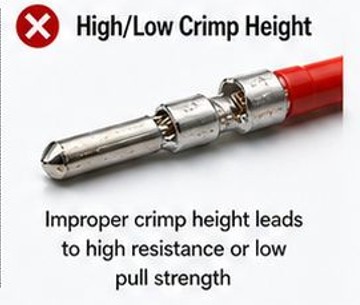
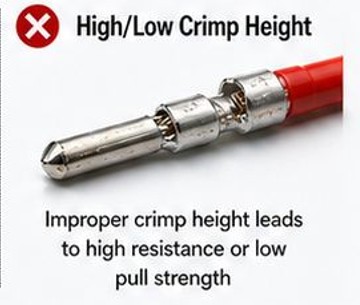
3. High/Low Crimp Height:
Crimp height is the most critical measurement used to evaluate a crimp's mechanical and electrical quality. A low crimp height means the terminal barrel has been over-compressed.
Technical Consequence: Over-compression squashes and deforms the copper strands excessively. Instead of creating a tight, cohesive metal mass, it work-hardens the copper, making the joint brittle and severely reducing its pull-out strength. The strands are prone to fracturing under minimal stress.
Typical Root Cause: Incorrect calibration of the crimping press; wrong applicator dial settings; or using a terminal that is mismatched to the wire gauge (AWG).
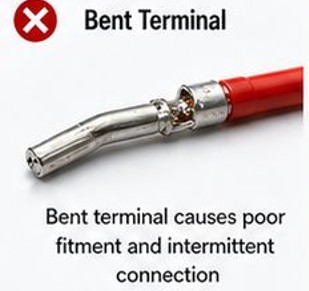
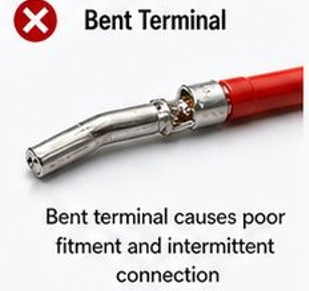
4. Terminal Bending:
This occurs when the functional body of the terminal (the male pin or female receptacle) becomes twisted, warped, or bent upward/downward relative to the crimped section.
Technical Consequence: A bent terminal cannot align properly with the cavities of a connector housing, leading to assembly failures. If it is forced into a housing, it will cause poor mating contact with the opposing pin, resulting in intermittent signals or complete open circuits.
Typical Root Cause: Worn terminal guide rails or a misaligned feed mechanism in the applicator; a worn anvil/punch; or excessive force applied by the terminal strip feed pawl.
5. Missing Strands:
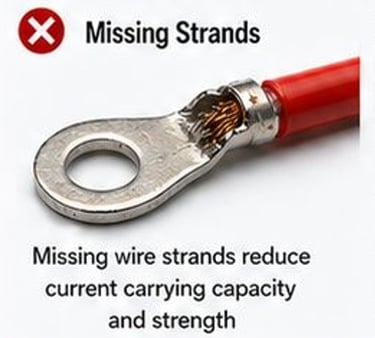
This defect happens when some of the wire's conductor strands fail to enter the terminal barrel entirely and are left spread or splayed outside the crimp.
Technical Consequence: Similar to cut strands, the missing strands reduce the effective gauge of the wire trapped inside the barrel. This leads to a high-resistance electrical joint, voltage drops, and localized thermal heating, while drastically weakening the physical grip.
Typical Root Cause: Poor manual handling by operators; a sloppy wire-transfer unit on automated cut-strip-crimp machines; or wire strands flaring out due to an overtightened or worn stripping blade during the jacket removal phase.
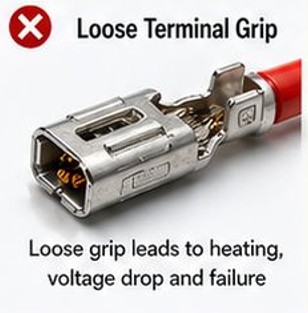
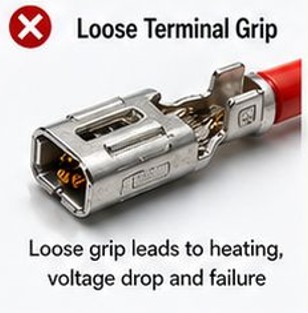
6. Insulation Damage / Loose Insulation Grip:
The insulation crimp barrel is designed to wrap firmly around the outer jacket to provide strain relief. This defect involves either the terminal puncturing and damaging the insulation jacket, or failing to grip it tightly enough (loose grip).
Technical Consequence: If the grip is loose, any external pulling, bending, or flexing forces will pull directly on the delicate wire strands inside the conductor crimp, leading to wire pull-out. If the insulation is punctured or torn, it exposes the bare wire to moisture ingress, environmental corrosion, and potential short circuits.
Typical Root Cause: Using the wrong terminal for the wire's outer diameter (OD); incorrect adjustment of the insulation crimp height on the applicator; or worn insulation punch tooling.